

Making Hybrid UC / OccMed Staffing Work — Without Adding Staff
When hybrid urgent care–occupational medicine clinics underperform financially, occupational health is often the first thing blamed. In reality, the issue is usually structural. Occ health was added onto an urgent care model without adjusting how the day is scheduled, staffed, or managed to reflect how different that work actually is.
That distinction matters, because the financial data around well-run occupational health programs is remarkably consistent. Clinics that manage hybrid operations intentionally tend to cluster around the same operating ranges:
Total labor: ~52–60% of revenue
Fixed facility costs: ~12–18%
Variable operating expenses: ~10–16%
Billing, IT, and administrative overhead: ~7–12%
Sustainable operating margin: ~12–18%
When hybrid clinics fall outside these ranges, it’s rarely because occupational health doesn’t “pay.” It’s because staffing and workflow were never recalibrated once employer services were introduced.
How the Problem Shows Up Day to Day
In many blended clinics, occupational health visits are treated as simple inserts into the urgent care schedule. A post-offer exam between walk-ins. A first-aid injury squeezed into an already busy morning. A DOT physical layered onto a provider day built for episodic care.
None of this feels unreasonable in isolation. But over time, the pattern creates friction.
Staff are scheduled to cover peak urgent care demand. Occupational health work arrives intermittently and pulls medical assistants, nurses, and providers out of UC flow. Throughput slows, handoffs increase, and labor costs creep upward—not because staffing levels are excessive, but because capacity is being consumed inefficiently.
This is how clinics quietly drift above the 60% labor threshold while leadership struggles to pinpoint the cause.
What Strong Hybrid Clinics Do Instead
High-performing hybrid clinics don’t solve this by creating separate teams. They solve it by redesigning the day.
They recognize that occupational health work is fundamentally more predictable than urgent care. Employer exams, surveillance testing, and follow-up visits can be scheduled, batched, and timed. Instead of allowing those visits to interrupt urgent care flow, they are placed deliberately into the day.
Occupational health blocks are aligned with historically lower urgent care demand. Peak UC hours are protected. The same cross-trained staff remain productive, but their time is deployed with more intention.
The result is not more staff—it’s better utilization. Labor costs stabilize back into the low-to-mid 50% range, where hybrid models tend to perform best.
Right-Sizing Staffing Intensity
Another difference in financially stable hybrid clinics is how visits are staffed.
Not every encounter is treated as if it requires urgent-care-level intensity. First-aid injuries, post-offer exams, and surveillance services are largely protocol-driven. Medical assistants and nurses carry much of the workflow. Provider time is reserved for decision-making, exams, and regulatory sign-off.
This approach protects provider capacity and reduces unnecessary labor drag. Variable operating expenses stay within the expected 10–16% range, and billing and administrative costs are less likely to balloon downstream trying to compensate for inefficiencies upstream.
Using Occupational Health to Stabilize the Operation
Well-managed hybrid clinics also stop viewing occupational health as a disruption and start using it as a stabilizer.
Scheduled employer services fill naturally slower periods. Predictable follow-ups smooth daily and seasonal swings. Rather than reacting to urgent care volatility, leadership gains a lever to shape demand and smooth staffing needs.
Over time, this stability shows up in the numbers: more consistent margins, fewer staffing surprises, and less reliance on urgent care peaks to carry the month.
The Financial Advantage Is Subtle—but Real
None of these changes require a separate occupational health staff or a parallel operating model. The cost structure remains shared. What changes is how the work is organized.
Clinics that manage hybrid staffing this way tend to:
Keep labor within 52–60% of revenue
Hold fixed costs near 15%
Maintain operating margins in the 12–18% range
Grow occupational health revenue without diluting urgent care performance
The improvement doesn’t come from a single dramatic move. It comes from aligning staffing with how work actually shows up during the day.
Bottom Line
Hybrid urgent care–occupational medicine clinics don’t improve financially by adding staff or creating silos. They improve by being more deliberate about how shared staff time is used.
When occupational health is scheduled thoughtfully, staffed to its true complexity, and used to smooth demand rather than interrupt it, the same team can deliver stronger access, better employer service, and materially better financial performance.
Members - check out Financial Benchmarking Resources here in the Occnation resource library.
In a future issue, we’ll walk through a practical example of how a modest redesign of the clinic day—without changing headcount—can move labor costs by several percentage points.
Need help with your program operations? Meet with me here.
— Larry Earl, MD
President, NAOHP
Uberdoc is a digital healthcare platform that connects patients and employers with top doctors through transparent pricing and fast access.

Uberdoc has exams available right now in most parts of the country. Reply here if you're ready to accept exams from Uberdoc and we'll get you set up. (members only)
🎥 Webinar Replay: Employer Communication in Occupational Health
If you weren’t able to attend live, or want to revisit specific segments, the full replay is now available:
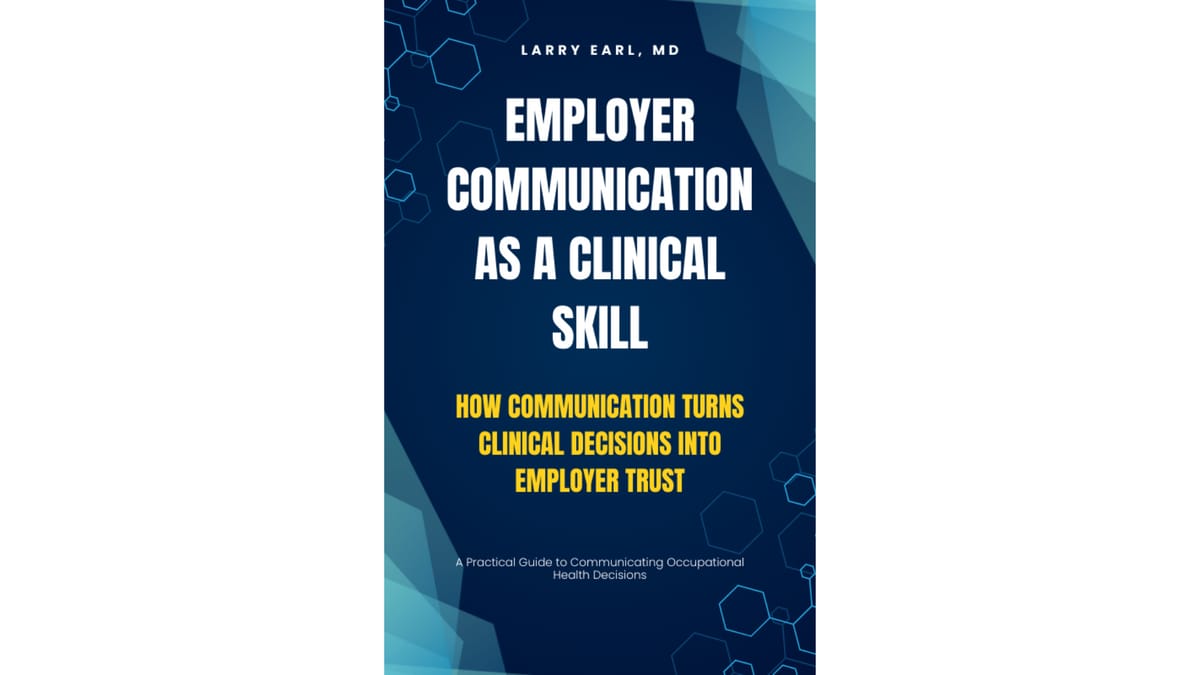
📘 Go Deeper: Employer Communication Practice Guide (Ebook)
The webinar intentionally stayed high-level. For those looking to operationalize these concepts inside their own clinic or health system, we’ve developed a companion Employer Communication Practice Guide.
This ebook expands on:
What employers should (and should not) receive for common occupational health services
Standardized communication pathways by service line
Documentation guardrails that reduce friction and legal risk
Real-world examples you can adapt to your workflows
👉 Access the Employer Communication ebook:
🤝 Want Hands-On Help? 1:1 Strategy Sessions with SensiaTech
For organizations that want to move beyond theory and actively improve employer communication at scale, NAOHP is offering 1:1 consultative sessions in partnership with SensiaTech.
These sessions are designed for clinics and health systems that want to:
Identify where employer communication is breaking down today
Improve intake, documentation flow, and employer-facing outputs
Strengthen employer trust while maintaining clinical and regulatory integrity
Align communication practices with technology and workflow design
Revolutionize Employee Healthcare with Sensia Tech™

New Cohort Started last Monday, you can still join and watch that recording:
Certified Work Comp Injury Management Professional (CWIMP)
For clinicians and operational leaders who want to move beyond episodic injury care and build disciplined, employer-trusted injury management programs. CWIMP focuses on the practical systems behind consistent triage, defensible decisions, effective employer communication, and predictable outcomes across workers’ compensation cases.

Sales & Marketing Office Hours
How many follow-ups are actually appropriate before an employer is truly not interested?
In our February Occ Med Sales Office Hours, we’ll break down how effective outreach cadence really works, why silence isn’t the same as disinterest, and how to stay persistent without damaging relationships.
You’ll learn how to interpret light signals, set realistic follow-up expectations, and apply disciplined persistence that reflects how Occ Med decisions actually unfold.

Persistence Without Annoyance: Designing Your Occ Med Outreach Cadence
Date: February 12th |
10 a.m. Pacific, 1 p.m. Eastern
Speaker: Ira Pasternack, Dave Saslavsky

Individual Certification - with Dena Kirk
Individual Certification in Occupational Health Practice Management is the perfect way for you to make sure you have what it takes to run a successful occupational health program. This two-year certificate will help equip you with the skills and knowledge necessary to implement an effective occupational health model, as well as provide guidance on staffing models, financial management, quality management and more

Becoming a Safety Leader in Healthcare
The Expanding Role of the Nurse in Health Care Safety
Goal: Master the evolving intersection of occupational health and safety leadership.
Key Topics:
• Shifting expectations of OHNs: from clinical care to system safety oversight.
• Understanding the dual lens of employee and patient safety.
• Introduction to Total Worker Health® principles in hospital settings.
• The business case for nurse-led safety programs (ROI, risk reduction, engagement).

Target Audience:
Registered Nurses, Occupational Health Nurses, and Employee Health professionals transitioning into or expanding safety leadership roles in healthcare systems.
Free Intro Class:
Date: March 19, 2026, 9 AM Pacific
Speaker: Shanna Dunbar
Recent Events:

🏭 Occupational Health Industry News & Signals
Workplace Injury Rates Reach Multi-Decade Lows
New analysis indicates U.S. workplace injury and illness rates have fallen to their lowest levels in decades, driven by improved safety culture, targeted enforcement, and post-pandemic shifts in work practices.
🔗 https://news.bloomberglaw.com/daily-labor-report/workplace-injuries-plunge-after-enforcement-culture-shift
NIOSH January 2026 Research & Program Updates Released
The latest NIOSH eNews highlights current research priorities, emerging hazards, and updated worker health resources following partial restoration of agency staffing.
🔗 https://www.cdc.gov/niosh/enews/enewsv23n3.html
OSHA Continues Emphasis on Practical Safety Guidance
Recent OSHA updates reinforce prevention-focused guidance and employer education as core tools alongside enforcement.
🔗 https://www.osha.gov/quicktakes/01142026
Workplace Stress Persists Despite Wellness Perks
New research finds employee stress levels remain high despite expanded wellness incentives, suggesting structural and operational factors drive psychosocial risk more than isolated benefits.
🔗 https://people.com/stress-at-work-doesnt-decrease-lifestyle-perks-incentives-new-study-finds-11901480
NIOSH Staffing Reinstatement Viewed as Positive but Incomplete
Industry groups note that while recent NIOSH staffing reinstatements are encouraging, gaps remain that could affect long-term occupational health research capacity.
🔗 https://ohsonline.com/articles/2026/01/14/nsc-says-niosh-staffing-reinstatement-is-encouraging-but-incomplete.aspx
In brief: Injury trends continue to improve, federal safety guidance remains central to employer decision-making, and psychosocial risk is emerging as a major workplace health challenge—reinforcing the clinic’s role in prevention, functional assessment, and employer communication.