

In partnership with

Honoring Dr. Martin Luther King Jr. Day
As we observe Dr. Martin Luther King Jr. Day, we’re reminded that dignity, fairness, and respect are not abstract ideals—they are lived values reflected in daily work and human interactions.
In occupational health, we care for workers from every background, including many immigrants whose labor sustains essential industries across healthcare, construction, manufacturing, agriculture, and service sectors. These individuals contribute skill, resilience, and dedication—often while navigating an uncertain and burdensome path to legal status, stability, and full participation in civic life.

Dr. King spoke often about the dignity of work and the moral responsibility to recognize the humanity of every person. That message remains relevant in settings like ours, where health, employment, and opportunity intersect.
On this day, we pause to acknowledge the contributions of immigrant workers we serve every day—and to reaffirm the principle that safe work, fair treatment, and respectful care are fundamental expressions of equality.
President’s Message
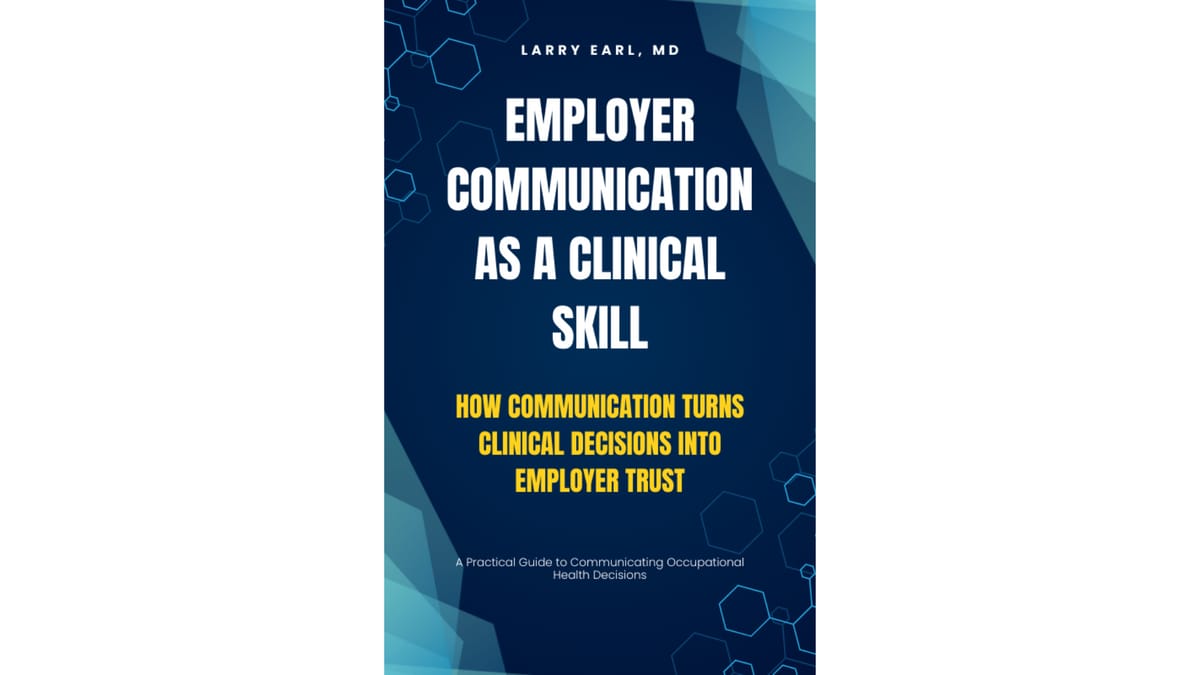
Employer Communication Is a Clinical Skill
In occupational health, we often treat employer communication as an administrative function—something that happens after the “real” clinical work is done.
In practice, it’s rarely that simple.
Employer communication shapes how clinical decisions are understood, acted upon, and trusted. It influences return-to-work outcomes, dispute frequency, and whether an employer sees a clinic as a partner or merely a vendor.
That makes employer communication not just an operational task, but a clinical skill.
Where Communication Breaks Down
Most communication issues don’t stem from lack of effort or goodwill. They arise when:
Clinical decisions are sound but poorly explained
Documentation answers the clinical question but not the employer’s operational one
Messages vary depending on which provider or staff member is involved
Expectations are assumed rather than explicitly set
From the employer’s perspective, these gaps feel like inconsistency—even when care quality is high.
From the clinic’s perspective, they feel like unnecessary friction, rework, and escalation.
Clinical Decisions Don’t Stand Alone
In occupational health, a clinical determination almost always has downstream consequences:
Fitness-for-duty affects staffing and safety
Work restrictions affect productivity and accommodation planning
Injury classification affects reporting, claims, and cost
When communication doesn’t anticipate those realities, employers are left to interpret decisions on their own—often incorrectly.
Strong programs recognize that how a decision is communicated is inseparable from what the decision is.
What Skilled Employer Communication Looks Like
Clinics that treat employer communication as a clinical competency tend to share a few characteristics:
Providers and staff use a shared language when explaining decisions
Documentation is written with both clinical and employer audiences in mind
Expectations about scope, timing, and follow-up are set early
Escalation pathways are clear before conflict arises
Importantly, this consistency doesn’t depend on one highly experienced individual. It’s built into the program.
From Individual Talent to Program Capability
Many clinics already have people who are excellent communicators. The challenge is that those skills often live at the individual level.
When communication depends on who happens to be on duty, employer confidence becomes fragile. When it’s formalized—through training, templates, and shared standards—it becomes a reliable part of care delivery.
This is one of the quiet markers of program maturity:
employers experience the clinic as predictable, even when cases are complex.
Why This Matters Now
As employer expectations rise, clinics are being evaluated not just on responsiveness, but on clarity, defensibility, and consistency.
Employer communication isn’t a soft skill layered on top of clinical care. It’s part of delivering care responsibly in a work-focused environment.
Programs that invest in this capability reduce friction, protect relationships, and position themselves as long-term partners rather than transactional service providers.
Continuing the Conversation
This week’s OccNation discussion builds on this theme by asking where communication feels most fragile in real workflows—and how programs are working to make it more consistent.
Thursday Webinar: Employer Communication in Practice
If this topic resonates, we’ll be going deeper later this week.
Thursday’s webinar, led by Andrew Seter, will focus on how clinics operationalize employer communication—particularly where documentation, fitness-for-duty decisions, and expectations intersect.
This session is sponsored by SensiaTech and will explore practical approaches clinics are using to reduce friction and strengthen employer trust.
— Larry Earl, MD
President, NAOHP
Payroll errors cost more than you think

While many businesses are solving problems at lightspeed, their payroll systems seem to stay stuck in the past. Deel's free Payroll Toolkit shows you what's actually changing in payroll this year, which problems hit first, and how to fix them before they cost you. Because new compliance rules, AI automation, and multi-country remote teams are all colliding at once.
Check out the free Deel Payroll Toolkit today and get a step-by-step roadmap to modernize operations, reduce manual work, and build a payroll strategy that scales with confidence.
👉 NAOHP Program Certification
For clinics ready to formalize workflows, strengthen internal infrastructure, and build durable occupational health programs.
Learn More »
👉 From Transactions to Partnerships
Guidance for clinics looking to elevate employer relationships beyond episodic visits toward long-term collaboration.
Get My New Book »
👉 Certified Work Comp Injury Management Professional (CWIMP)
For clinicians and operational leaders who want to move beyond episodic injury care and build disciplined, employer-trusted injury management programs. CWIMP focuses on the practical systems behind consistent triage, defensible decisions, effective employer communication, and predictable outcomes across workers’ compensation cases.
Next Class Enrolling Now - Starts February 2
Uberdoc is a digital healthcare platform that connects patients and employers with top doctors through transparent pricing and fast access.

Uberdoc has exams available right now in most parts of the country. Reply here if you're ready to accept exams from Uberdoc and we'll get you set up. (members only)
New Resource: From Transactions to Partnerships
Most occupational health programs say they want stronger employer relationships — but few stop to examine what actually makes those relationships durable.
From Transactions to Partnerships explores the shift from episodic, visit-based interactions toward employer relationships built on consistency, shared expectations, and trust over time. Rather than focusing on sales tactics, the book looks at the operational realities that either strengthen or undermine partnerships: communication discipline, workflow predictability, documentation standards, and role clarity.
This is a practical guide for clinic leaders and clinicians who recognize that long-term employer confidence isn’t created in a single visit — it’s built through repeatable systems and aligned behaviors.

Revolutionize Employee Healthcare with Sensia Tech™

One Page. One Practice Win. Every Week
Practice Tip of the Week: Consistency Beats Persuasion in Employer Communication — Employers don’t need persuasion. They need predictability:
In occupational health, employer trust is built less on how well you explain decisions—and more on how consistently those decisions show up over time.
Many clinics run into trouble not because their clinical reasoning is wrong, but because the same situation is explained differently depending on the provider, the day, or who took the call.
From the employer’s perspective, that feels like uncertainty—even when care is clinically sound.

Recent Practict Tips:


What’s Happening This Week
Upcoming Webinars & Trainings
👉👉 All events will be recorded, please go ahead and register even if you can't make it, we'll send the recording link when available
Effective Communication in Occupational Health
Join us for an insightful webinar designed for occupational health professionals seeking to improve communication with employer clients, patients, and other key stakeholders. Effective communication is crucial for delivering high-quality occupational health services, from regulated exams and drug screenings to workers' compensation and wellness programs.


Date: January 22, 2026, 9 AM Pacific
Speaker: Andrew Seter, MD
Sensiatech
Certified Work Comp Injury Management Professional (CWIMP)
For clinicians and operational leaders who want to move beyond episodic injury care and build disciplined, employer-trusted injury management programs. CWIMP focuses on the practical systems behind consistent triage, defensible decisions, effective employer communication, and predictable outcomes across workers’ compensation cases.

Next Class starts February 2, 2026
Free Intro Class:
Date: January 26, 2026, 1 PM Pacific
Speaker: Michael Stack
Individual Certification - with Dena Kirk
Individual Certification in Occupational Health Practice Management is the perfect way for you to make sure you have what it takes to run a successful occupational health program. This two-year certificate will help equip you with the skills and knowledge necessary to implement an effective occupational health model, as well as provide guidance on staffing models, financial management, quality management and more

Becoming a Safety Leader in Healthcare
The Expanding Role of the Nurse in Health Care Safety
Goal: Master the evolving intersection of occupational health and safety leadership.
Key Topics:
• Shifting expectations of OHNs: from clinical care to system safety oversight.
• Understanding the dual lens of employee and patient safety.
• Introduction to Total Worker Health® principles in hospital settings.
• The business case for nurse-led safety programs (ROI, risk reduction, engagement).

Target Audience:
Registered Nurses, Occupational Health Nurses, and Employee Health professionals transitioning into or expanding safety leadership roles in healthcare systems.
Free Intro Class:
Date: February 19, 2026, 9 AM Pacific
Speaker: Shanna Dunbar
Recent Events:

Grow your business to new heights with Net Health’s Occupational Health EMR.
🏭 Occupational Health Industry News & Signals
Industry News — Week of January 19, 2026
NIOSH Staffing Reinstated After Cuts
Federal officials have begun bringing back nearly 900 staff at the National Institute for Occupational Safety and Health (NIOSH) following widespread concern over deep workforce reductions in 2025. The layoffs had severely curtailed research, safety certification, and worker health initiatives, prompting criticism from advocates across industries. Reinstating personnel may restore key research functions and employer-facing tools, though residual gaps remain from earlier reductions.
Why it matters: A stronger NIOSH supports occupational health evidence, respirator and PPE guidance, and hazard evaluation programs that clinics may reference when advising employers. Renewed staffing could improve access to state-of-the-science resources for complex case support and consultation.
OSHA Extends Hazard Communication Compliance Dates
OSHA has extended compliance dates for its updated Hazard Communication Standard, giving regulated entities additional time to review guidance materials before provisions take effect in May 2026.
Why it matters: More time to prepare means clinics and employers can align hazard communication training, SDS access, and labeling practices without rushing implementation — which can reduce confusion and protect workplaces from enforcement risk.
Occupational Medicine Market Poised for Growth
New market analysis projects the global occupational medicine sector to nearly double from 2024 to 2035, with a forecasted value of USD 11 billion and a compound annual growth rate near 7%. Growth drivers include increased employer investment in preventive care, regulatory compliance services, and digital health adoption.
Why it matters: Sustained market expansion signals opportunities for clinic growth, tech-enabled services, and partnerships that extend beyond traditional injury care — especially where communication and program design reinforce value.
OSHA Consultation Programs Highlighted
OSHA’s Office of Small Business Assistance has been actively promoting its On-Site Consultation Program, a free, confidential compliance resource that helped over 21,000 employers strengthen safety and health practices in 2024.
Why it matters: These cooperative programs are underutilized tools for employers and clinics to jointly assess hazards, implement preventive controls, and optimize injury prevention without fear of enforcement — a potential value-add in employer advisory conversations.
Emerging Occupational Health & Safety Trends
Broader industry analysis underscores a shift in workplace safety priorities for 2026:
integration of AI and digital tools for hazard prediction and monitoring
evolving regulatory pressure on heat illness prevention and violence response planning
expanded employer focus on mental health as a core component of workplace safety
These trends reflect a widening definition of occupational health beyond injury care to holistic risk management.
Why it matters: Clinics that can frame occupational health in terms of comprehensive risk reduction — including psychosocial and environmental factors — are better positioned to partner with employers on long-term safety strategy.
In brief: Regulatory timelines are shifting, federal safety infrastructure is stabilizing, and market forces are favoring integrated occupational health services. For occupational health professionals, these developments reinforce the importance of proactive communication, comprehensive risk assessment, and employer partnership in guiding workplace health decisions.
Firefighter Medical Oversight & Cancer Risk Awareness
What’s happening:
Firefighter Cancer Awareness Month continues to draw attention to how fire departments and clinics approach cancer risk, medical surveillance, and fitness-for-duty evaluations. Questions persist around how closely current practices align with guidance from organizations such as NFPA, particularly when protocols have evolved informally over time.
Why it matters:
Clinics serving fire departments are increasingly expected to demonstrate not just clinical competence, but structured protocols, clear documentation, and consistent communication with departments and medical directors. Informal or provider-dependent approaches create risk as scrutiny increases.
🔗 Read more:
Firefighter cancer risk and occupational exposure overview
https://www.cdc.gov/niosh/firefighters/cancer.html
👉 Related resource:
Firefighter Medical Exam Protocol Development (Coming Soon)
Guidance to help clinics align firefighter exam workflows with NFPA expectations and support department-facing medical governance conversations.