

President’s Day Edition
If You Can’t Explain It, You Don’t Control It
Today we celebrate leadership.
But leadership is not a title.
It’s the ability to answer uncomfortable questions clearly.
Here’s one that silences more executive teams than you’d expect:
“What would our occupational health program cost if we had to buy it externally?”
Not a rhetorical question.
Not a philosophical one.
A financial one.
In most large health systems, occupational health touches every employee. It supports onboarding, surveillance, testing, injury care, regulatory compliance, accommodations, and workforce safety.
It is often a multi-tens-of-millions-dollar function.
And yet…
Ask for a clean, market-based explanation of what it represents, and the answers usually dissolve into:
Headcount
Cost centers
Historical budgets
“We’ve always done it this way”
That’s not strategy.
That’s operational inheritance.
Here’s the uncomfortable truth:
If you cannot explain a function in enterprise terms, you are not managing it — you are simply running it.
There is a difference.
This isn’t about whether your clinicians are excellent.
They likely are.
It isn’t about compliance.
You are almost certainly compliant.
It’s about whether leadership can say, without hesitation:
What is unavoidable compliance cost?
What is discretionary?
What is strategic?
What is being assumed but never evaluated?
What would replacement actually look like?
I recently worked with a system that faced this exact moment.
Nothing was broken.
But when leadership tried to step back and see occupational health the way they evaluate other enterprise services — with benchmarks, comparability, and defensibility — they realized something important:
They had never translated it.
Once they did, the conversation changed dramatically.
Occupational health stopped being:
“Something we have to operate”
And became:
“Something we can intentionally manage.”
That is leadership.
On President’s Day, it’s worth asking yourself:
If your CFO put that question on the agenda tomorrow, would the room get quiet?
If so, you may find this deeper analysis worth your time:
Leadership isn’t about comfort.
It’s about clarity.
— Larry
Uberdoc is a digital healthcare platform that connects patients and employers with top doctors through transparent pricing and fast access.

Uberdoc has exams available right now in most parts of the country. Reply here if you're ready to accept exams from Uberdoc and we'll get you set up. (members only)
🎥 Webinar Replay: Employer Communication in Occupational Health
If you weren’t able to attend live, or want to revisit specific segments, the full replay is now available:
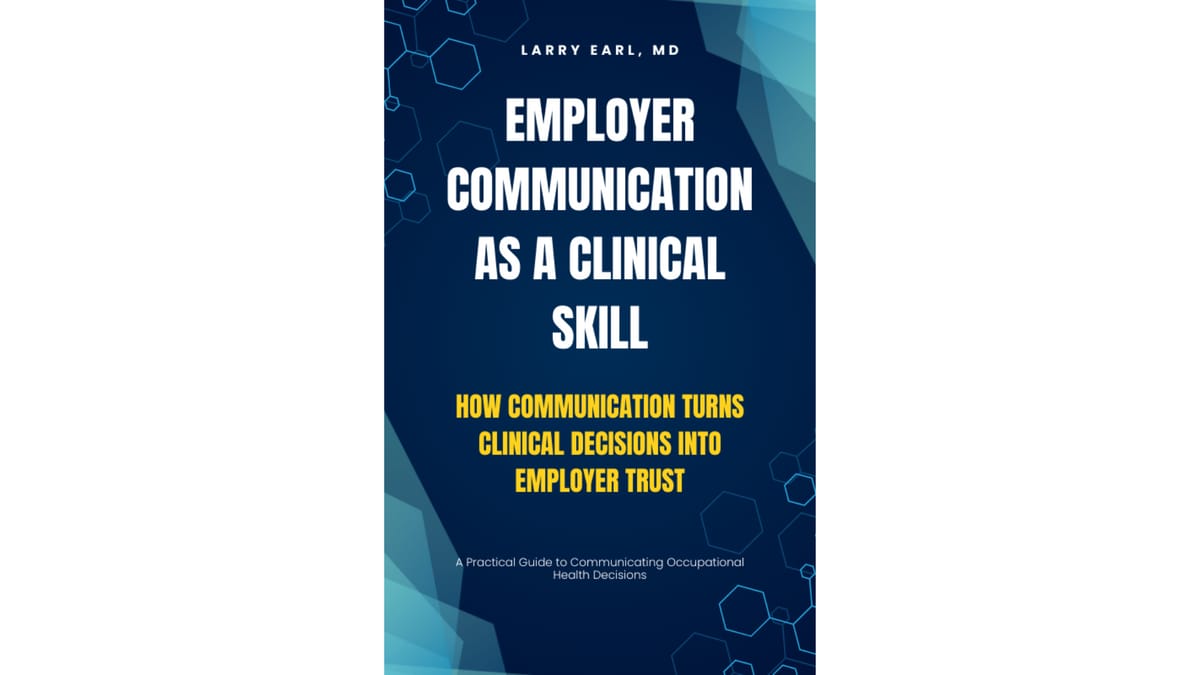
📘 Go Deeper: Employer Communication Practice Guide (Ebook)
The webinar intentionally stayed high-level. For those looking to operationalize these concepts inside their own clinic or health system, we’ve developed a companion Employer Communication Practice Guide.
This ebook expands on:
What employers should (and should not) receive for common occupational health services
Standardized communication pathways by service line
Documentation guardrails that reduce friction and legal risk
Real-world examples you can adapt to your workflows
👉 Access the Employer Communication ebook:
🤝 Want Hands-On Help? 1:1 Strategy Sessions with SensiaTech
For organizations that want to move beyond theory and actively improve employer communication at scale, NAOHP is offering 1:1 consultative sessions in partnership with SensiaTech.
These sessions are designed for clinics and health systems that want to:
Identify where employer communication is breaking down today
Improve intake, documentation flow, and employer-facing outputs
Strengthen employer trust while maintaining clinical and regulatory integrity
Align communication practices with technology and workflow design
Revolutionize Employee Healthcare with Sensia Tech™

Individual Certification - with Dena Kirk
Individual Certification in Occupational Health Practice Management is the perfect way for you to make sure you have what it takes to run a successful occupational health program. This two-year certificate will help equip you with the skills and knowledge necessary to implement an effective occupational health model, as well as provide guidance on staffing models, financial management, quality management and more


Becoming a Safety Leader in Healthcare
The Expanding Role of the Nurse in Health Care Safety
Goal: Master the evolving intersection of occupational health and safety leadership.
Key Topics:
• Shifting expectations of OHNs: from clinical care to system safety oversight.
• Understanding the dual lens of employee and patient safety.
• Introduction to Total Worker Health® principles in hospital settings.
• The business case for nurse-led safety programs (ROI, risk reduction, engagement).

Target Audience:
Registered Nurses, Occupational Health Nurses, and Employee Health professionals transitioning into or expanding safety leadership roles in healthcare systems.
Free Intro Class:
Date: March 19, 2026, 9 AM Pacific
Speaker: Shanna Dunbar
Recent Events:

🏭 Occupational Health Industry News & Signals
Federal Investigators Cite Safety Failures in Fatal Steel Plant Explosion
OSHA cited a U.S. Steel facility after an explosion killed two workers and injured others, finding inadequate procedures, training gaps, and hazardous gas exposure risks.
🔗 https://apnews.com/article/b6189f8d4df576f81cadf37b89154d39
Why it matters for clinics:
Events like this highlight the importance of exposure protocols, respiratory protection guidance, and post-incident medical surveillance.
OSHA Extends Hazard Communication Compliance Deadlines
OSHA extended compliance timelines for updated Hazard Communication Standard requirements to allow additional guidance and employer preparation time.
🔗 https://www.osha.gov/quicktakes/01152026
Why it matters for clinics:
Employers may seek help interpreting SDS updates, chemical labeling changes, and employee training needs.
NIOSH Staffing Reinstated, Research Capacity Recovering
Federal action has reinstated hundreds of NIOSH employees, restoring critical worker safety research and guidance capacity.
🔗 https://federalnewsnetwork.com/workforce/2026/01/hhs-reinstates-all-laid-off-employees-at-workplace-safety-agency-niosh/
Why it matters for clinics:
Improved federal research support strengthens guidance on PPE, respirators, and exposure risk assessment used in employer consults.
OSHA Investigations Continue to Highlight Trenching & Excavation Risks
Recent investigations continue to emphasize trench collapse hazards and enforcement tied to inadequate protective systems.
🔗 https://www.osha.gov/news/newsreleases
Why it matters for clinics:
High-risk industries depend on clear fitness-for-duty decisions and timely return-to-work planning following serious incidents.
Falls, Slips, and Routine Task Injuries Remain Leading Causes of Worker Harm
Safety advisories emphasize that slips, trips, and falls remain a leading cause of workplace injuries across sectors.
🔗 https://www.the-sun.com/news/15932984/usps-postal-workers-new-walking-directive/
Why it matters for clinics:
Seemingly minor injuries drive significant visit volume and lost productivity—reinforcing the value of prevention guidance and functional recovery planning.
In brief:
Serious incident investigations, evolving chemical safety rules, and restored federal safety research capacity reinforce the clinic’s role in exposure management, functional assessment, and employer guidance.