

President’s Message
President’s Message | Consistency Is Not Optional
Over the past week, a recurring theme has surfaced in conversations with members, partners, and program leaders: inconsistency. Not at the margins—but at the core of how occupational health is being delivered.
Even well-established programs struggle with variation. The same service looks different across locations. The same condition leads to different work restrictions, time loss, or OSHA recordability depending on the provider. Employer communication and documentation vary widely. And in rural or primary-care–based settings—often the only local source of occupational health—services are sometimes delivered with minimal engagement or, frankly, open disdain.
This is not a critique of individuals. It is a systems problem.
Occupational health cannot scale—or earn employer trust—without consistency. And consistency does not happen by accident.
Introducing the OccHealth Consistency Project
In response, we are developing the OccHealth Consistency Project—an initiative designed to help programs move from individual practice patterns to system-level reliability.
The goal is not to eliminate clinical judgment. The goal is to ensure that judgment is applied within a shared framework so that employers, workers, and clinic leaders can expect predictable, defensible outcomes regardless of location or provider.
This project is being built around three integrated pillars:
1. Standardized policies and procedures
Aligned with NAOHP Program Certification principles, this will define the non-negotiables:
Core workflows for common services and conditions
Decision thresholds for work restrictions, follow-up, and employer reporting
Documentation standards that protect the clinic and serve the employer
Not a binder on a shelf—but practical, teachable standards.
2. Micro-learning, available at the moment of need
Instead of one-time training, we are designing:
Short, targeted videos
Quick reference guides
Scenario-based “recipes” for common occupational health situations
These will be accessible in real time, when a provider or staff member needs guidance—not weeks later in a classroom.
3. Outcome monitoring and feedback tools
Consistency must be measurable. The project will include software-enabled tools to:
Track variation in outcomes (time loss, restrictions, recordability)
Reflect performance back to clinic and system leaders
Support coaching and improvement without blame
If we can’t see inconsistency, we can’t fix it.
What problems this will solve
The OccHealth Consistency Project is designed to address issues many of you have raised repeatedly:
Variation across multiple clinics or regions
Inconsistent employer communication and documentation
Provider and staff discomfort or disengagement with occupational health
Difficulty onboarding and training new staff
Lack of defensible, system-wide standards when outcomes are questioned
In short: it creates reliability where variability currently reigns.
Resources you can use now
While this project is under development, many existing NAOHP resources already help reduce inconsistency, especially across multi-site or non-occhealth-primary locations:
NAOHP Program Certification Standards – a foundation for operational alignment
Practice briefs on injury management, documentation, and employer communication
Training resources for OSHA-regulated exams and services
Workflow guides for work status reporting and return-to-work documentation
Educational content that reframes occupational health as a distinct clinical discipline—not an add-on
These are effective starting points, particularly for programs looking to stabilize performance today.
OccHealth Consistency Training Series — Interest List
Inconsistent outcomes across clinics are rarely a people problem. They are a systems problem.
We are developing a 3-session, application-focused training series for occupational health leaders who want to reduce unwarranted variation across sites, support providers with clear guidance, and improve employer confidence through consistent documentation and outcomes.
Participants will receive:
Practical frameworks for standardizing key occupational health workflows
Immediate-use procedures, guides, and decision tools
Early access to resources that will continue to evolve as part of this initiative
This will be a paid, limited-attendance series.
Joining the interest list does not obligate you to enroll—it simply ensures you receive early details when registration opens.
— Larry Earl, MD
President, NAOHP
Uberdoc is a digital healthcare platform that connects patients and employers with top doctors through transparent pricing and fast access.

Uberdoc has exams available right now in most parts of the country. Reply here if you're ready to accept exams from Uberdoc and we'll get you set up. (members only)
🎥 Webinar Replay: Employer Communication in Occupational Health
Last Week’s webinar on Effective Employer Communication in Occupational Health generated strong engagement and thoughtful discussion—clear evidence that this remains one of the most challenging (and high-impact) aspects of occupational health practice.
If you weren’t able to attend live, or want to revisit specific segments, the full replay is now available:
The session focused on:
Why employer communication often breaks down despite good clinical intent
Common documentation and messaging missteps that create downstream conflict
Practical frameworks for aligning clinical decisions, OSHA requirements, and employer expectations
How clearer communication directly affects trust, utilization, and long-term employer relationships
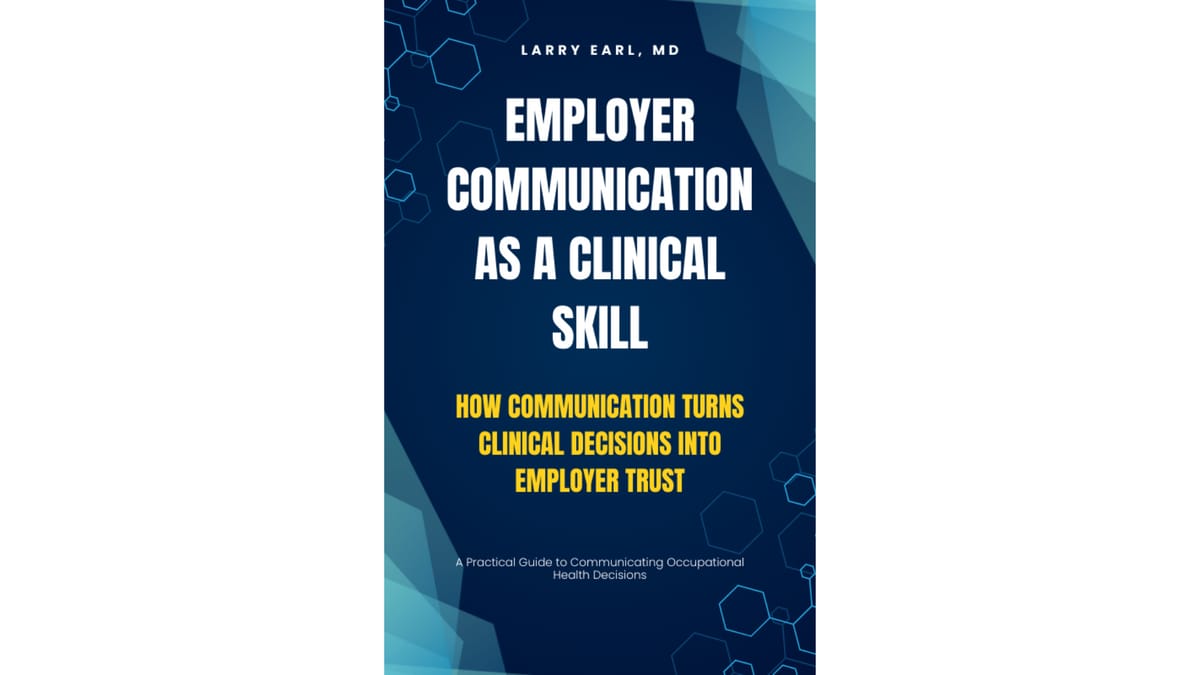
📘 Go Deeper: Employer Communication Practice Guide (Ebook)
The webinar intentionally stayed high-level. For those looking to operationalize these concepts inside their own clinic or health system, we’ve developed a companion Employer Communication Practice Guide.
This ebook expands on:
What employers should (and should not) receive for common occupational health services
Standardized communication pathways by service line
Documentation guardrails that reduce friction and legal risk
Real-world examples you can adapt to your workflows
👉 Access the Employer Communication ebook:
🤝 Want Hands-On Help? 1:1 Strategy Sessions with SensiaTech
For organizations that want to move beyond theory and actively improve employer communication at scale, NAOHP is offering 1:1 consultative sessions in partnership with SensiaTech.
These sessions are designed for clinics and health systems that want to:
Identify where employer communication is breaking down today
Improve intake, documentation flow, and employer-facing outputs
Strengthen employer trust while maintaining clinical and regulatory integrity
Align communication practices with technology and workflow design
Revolutionize Employee Healthcare with Sensia Tech™

New Cohort Starts Today at 1:30 pacific:
Certified Work Comp Injury Management Professional (CWIMP)
For clinicians and operational leaders who want to move beyond episodic injury care and build disciplined, employer-trusted injury management programs. CWIMP focuses on the practical systems behind consistent triage, defensible decisions, effective employer communication, and predictable outcomes across workers’ compensation cases.

Sales & Marketing Office Hours
How many follow-ups are actually appropriate before an employer is truly not interested?
In our February Occ Med Sales Office Hours, we’ll break down how effective outreach cadence really works, why silence isn’t the same as disinterest, and how to stay persistent without damaging relationships.
You’ll learn how to interpret light signals, set realistic follow-up expectations, and apply disciplined persistence that reflects how Occ Med decisions actually unfold.

Persistence Without Annoyance: Designing Your Occ Med Outreach Cadence
Date: February 12th |
10 a.m. Pacific, 1 p.m. Eastern
Speaker: Ira Pasternack, Dave Saslavsky

Individual Certification - with Dena Kirk
Individual Certification in Occupational Health Practice Management is the perfect way for you to make sure you have what it takes to run a successful occupational health program. This two-year certificate will help equip you with the skills and knowledge necessary to implement an effective occupational health model, as well as provide guidance on staffing models, financial management, quality management and more

Becoming a Safety Leader in Healthcare
The Expanding Role of the Nurse in Health Care Safety
Goal: Master the evolving intersection of occupational health and safety leadership.
Key Topics:
• Shifting expectations of OHNs: from clinical care to system safety oversight.
• Understanding the dual lens of employee and patient safety.
• Introduction to Total Worker Health® principles in hospital settings.
• The business case for nurse-led safety programs (ROI, risk reduction, engagement).

Target Audience:
Registered Nurses, Occupational Health Nurses, and Employee Health professionals transitioning into or expanding safety leadership roles in healthcare systems.
Free Intro Class:
Date: February 19, 2026, 9 AM Pacific
Speaker: Shanna Dunbar
Recent Events:

🏭 Occupational Health Industry News & Signals
NIOSH Staffing Restored
NIOSH has reinstated previously laid-off staff, restoring research and technical guidance capacity.
🔗 https://federalnewsnetwork.com/workforce/2026/01/hhs-reinstates-all-laid-off-employees-at-workplace-safety-agency-niosh/
Why it matters for clinics:
Stronger NIOSH capacity means better-backed guidance for PPE, exposure assessment, and employer consult conversations. Clinics can more confidently reference federal research when advising employers.
OSHA Budget Pressure Continues
FY 2026 proposals suggest OSHA may face modest funding constraints despite stable safety expectations.
🔗 https://www.safetyandhealthmagazine.com/27804-fy-2026-budgets-for-osha-niosh-and-msha-coming-into-focus/
Why it matters for clinics:
Even with fewer resources, enforcement expectations don’t disappear. Employers may lean more on clinics for interpretation, documentation, and practical guidance.
Serious Injury Enforcement Emphasizes Supervision & Controls
Recent fines following serious injuries reinforce regulatory focus on basic hazard controls and frontline supervision.
🔗 https://news.ontario.ca/en/court/1006962/north-york-based-company-fined-140000-supervisor-fined-7000-after-serious-workplace-injury
Why it matters for clinics:
Post-injury care, work restrictions, and return-to-work decisions increasingly intersect with enforcement narratives. Clear, defensible clinical documentation matters.
Fatal Incidents Reinforce Fitness-for-Duty Importance
Recent heavy machinery and exposure-related fatalities highlight ongoing gaps in task-level safety and readiness.
🔗 https://www.news.com.au/national/queensland/news/man-killed-in-heavy-machinery-accident-at-the-port-of-brisbane/news-story/7dc005632a0a8149e361e815a93ea216
Why it matters for clinics:
Functional job understanding and precise fitness-for-duty decisions remain critical risk controls—not administrative tasks.
In brief:
Federal research capacity is stabilizing, enforcement expectations remain firm, and serious incidents continue to highlight the clinic’s role in clear clinical judgment, functional assessment, and employer communication.