

We hear it during site visits. We hear it in team huddles. Medical directors go out on client calls and bring back the same two complaints from employers, again and again:
"Employees are staying out too long." "The restrictions don't make sense — can't you just call us?"
When that feedback gets back to staff providers, the responses are predictable:
"I put down restrictions for home too — what's the point?" "They'll just argue with me." "I don't have time to play phone tag."
These are understandable frustrations. They are not valid reasons to stop calling. And here is the proof: when the medical director makes those same calls, there is almost never pushback. What there is, consistently, is gratitude.
The provider who dreads the call and the employer who is relieved to receive it are separated by a communication infrastructure problem. It is not a personality difference, and it is fixable. This is one of the central arguments in From Transactions to Partnerships — that sustainable occupational health growth is built through disciplined, structured communication, not clinical skill alone.
Employer Communication Is a Clinical Competency
Employer communication in occupational health is not a soft skill or a courtesy. It is a clinical competency, as essential as documentation, scope-of-practice decisions, or return-to-work protocols.
When a provider issues a restriction without calling the employer, here is what actually happens:
The employer receives a form with phrases like "light duty as tolerated" — and has no idea what that means for their operation
A supervisor improvises. HR escalates. Safety flags a compliance concern.
The employee shows up with paperwork the employer hasn't seen, or a fax arrives the next morning for a decision made at 2pm the day before
Nobody called. Nobody explained. The employer assumes the worst about the injury, the timeline, and your program's reliability
Meanwhile, the provider believes the case was handled well — because clinically, it was.
A well-reasoned clinical decision that is poorly communicated can produce worse outcomes than a more modest decision that is explained clearly. Employers do not judge your program on diagnostic nuance. They judge it on whether clinical decisions translate into safe, workable, understandable outcomes.
As From Transactions to Partnerships puts it: employers are not buying visits. They are buying risk containment. Every unanswered question and every unexplained restriction chips away at that confidence.
Four Events That Must Trigger a Provider-to-Employer Call
Not every visit requires a phone call. But certain clinical events are high-impact enough that direct provider communication is non-negotiable. These are program standards, not suggestions.
1. The Initial Injury Visit This is when employer expectations are set in real time — and when uncertainty is highest. A brief call after the first visit does more to prevent weeks of friction than any form or fax. The provider confirms the assessment, explains work status in functional terms, outlines the initial treatment plan, and sets reassessment expectations. This single call establishes your clinic as a partner rather than a transaction point.
2. Any Restriction That Affects Essential Job Functions When an employee is placed on modified duty — particularly when it affects core job tasks — the treating provider must personally communicate with the employer contact. The call explains why the restriction is necessary, what functional capacity remains, how long it is expected to last, and what would prompt a change. Without this call, employers assume restrictions are arbitrary or overly cautious. With it, they view modified duty as collaborative risk management.
3. Referrals and Advanced Diagnostics Referrals reset employer expectations every time. A referral to physical therapy, a specialist, or imaging is interpreted as a signal that the case has shifted from "routine" to "serious" — regardless of how common the referral may be clinically. When the provider calls to explain what the referral is intended to address and how it fits the return-to-work plan, employers are far more likely to support the decision and resist escalating unnecessarily.
4. Any Significant Change in the Clinical Picture Early optimism giving way to prolonged recovery, unexpected complications, or delayed improvement — these moments are mandatory communication checkpoints. Employers remember what they were initially told. When reality diverges from those expectations without explanation, trust erodes fast. A proactive call acknowledging what has changed, why, and what the revised plan looks like is professional transparency, not an admission of error.
The Phone Tag Objection Has a Real Answer
The "I don't have time for phone tag" objection points to the infrastructure problem — and it has a practical solution.
Providers do not have to initiate these calls themselves or wait on hold. Front desk and clinical staff can build a system around this:
Staff identifies cases that have triggered one of the four call events above
Staff contacts the employer to schedule a brief provider call, coordinating around times the provider is most available: between patients, before and after lunch, before shift end
When the employer is on the line, staff transfers to the provider — no hold time, no chasing, no phone tag
This is a workflow, not heroics. Programs that build this system find that provider-to-employer calls take less than five minutes in most cases — and prevent hours of downstream friction, escalation, and employer dissatisfaction.
Providers who say "I don't have time" are often spending far more time later responding to HR escalations, rewriting restriction forms, and defending decisions that were never explained in the first place.
This is the operational alignment argument made throughout From Transactions to Partnerships: internal systems either support growth or quietly erode it. A clinic cannot sell trust that its workflows cannot sustain.
👉👉 Are you interested in learning more about how to automate provider calls and documentation, creating consistency for the employer and smooth operations for your staff?
Stop Writing for Home. Write for Work.
One of the most telling provider responses is: "I put restrictions down for home too."
The instinct to write vague, protective restrictions that cover every possible scenario is a communication failure dressed up as clinical caution.
Part of what drives it is a legitimate clinical reality: occupational health providers are doing the full work of medicine. They are considering the patient's other medical conditions, home situation, hobbies, activity level, and the broader biopsychosocial context that shapes recovery. That conversation belongs between physician and patient, documented in the medical record as PHI. It does not belong in the employer-facing report.
The employer report is a separate document with a narrower, clearly defined purpose. It contains what the employer needs to know to manage the return-to-work process: the work-related diagnosis, a functional assessment of physical capabilities as they relate to the essential elements of the job, a realistic prognosis, and clarity on referrals and follow-up timing. Nothing more is required — and including more creates both privacy risk and operational confusion.
Restrictions written for that purpose look different from restrictions written to cover everything. They are precise, job-referenced, and time-bounded — which makes them something a supervisor can actually act on.
Consider the difference in how an employer experiences these two versions:
❌ "Light duty as tolerated. No heavy lifting. Follow up as needed."
✅ "Employee may perform sedentary to light tasks including standing, walking, and fine motor work. Avoid repetitive overhead reaching and lifting over 15 lbs. Reassessment in 10 days to evaluate for return to full duty."
The first version forces the employer to guess. The second gives them a functional prescription they can implement the same day. The medical record holds the full clinical picture. The employer report holds what is germane to returning to work — and that discipline, consistently applied, is what separates programs employers trust from programs they merely tolerate.
What Employer Feedback Is Actually Telling Us
When employees stay out too long, it is often because no one explained the expected recovery trajectory — so the employer couldn't plan modified duty and the employee had no clear functional milestones.
When restrictions "don't make sense," it is almost always because the clinical reasoning was never communicated — not because the restriction was wrong.
Mature occupational health programs recognize that inconsistency is the enemy of employer trust. If one provider calls and another doesn't, if one explains restrictions and another just faxes a form, employers experience the program as unreliable — regardless of individual clinical quality.
The litmus test: if a different provider handled the same case tomorrow, would the employer experience the decision the same way? If the answer is no, the program has a communication infrastructure problem, not a provider problem.
This is precisely the pattern described in From Transactions to Partnerships: programs that plateau are rarely failing clinically. They are failing structurally — because knowledge lives in people rather than systems, and outcomes depend on who happens to answer the phone.
This Is Learnable. This Is Teachable.
The medical director who makes calls without pushback hasn't stumbled onto a personality advantage. They have internalized a framework that every provider in occupational health can learn: how to translate clinical decisions into operational language, how to set expectations early, and how to handle escalation as clarification rather than confrontation.
This is exactly what we train inside the NAOHP Occupational Medicine Provider Course — from the four call triggers and OSHA recordability awareness, to meaningful return-to-duty notes and writing modified duty prescriptions that actually work.
Providers who go through this course stop dreading employer calls and start using them to build the relationships that make their clinical work sustainable.
For programs ready to think beyond individual calls and toward the broader architecture of employer trust, From Transactions to Partnerships by Larry Earl, MD provides a practical framework for moving occupational health programs from transactional service delivery to genuine employer partnership — through internal alignment, structured engagement, and communication systems that hold up regardless of who is on shift.
🎓 Enroll Your Providers This Month — Major Savings Available
Right now, enrolling in March gets your providers into our twice-monthly live provider office hours, where we cover:
Occupational medicine concepts and case studies
OSHA recordability in real clinical scenarios
Q&A on the exact situations your team is navigating now
Bundle Pricing — March Enrollment Only: (regularly $589)
Seats | Price Per Seat | Total Investment |
|---|---|---|
200 providers | $195/seat | $39,000 |
100 providers | $295/seat | $29,500 |
50 providers | $395/seat | $19,750 |
These bundles represent significant savings for programs that are serious about building communication discipline across their entire clinical team.
Providers get lifetime access to the course and all supporting materials, checklists, guides and workflows, as long as they are with your organization.
Use your discounted coupons to manage turnover and growth.
Employer trust is not built in quarterly meetings or strategy decks. It is built call by call, restriction by restriction, referral by referral — through predictable, professional communication that turns clinical decisions into operational clarity.
Your providers can learn this. Your program can build it. And your employers are already asking for it.
Additional Resources

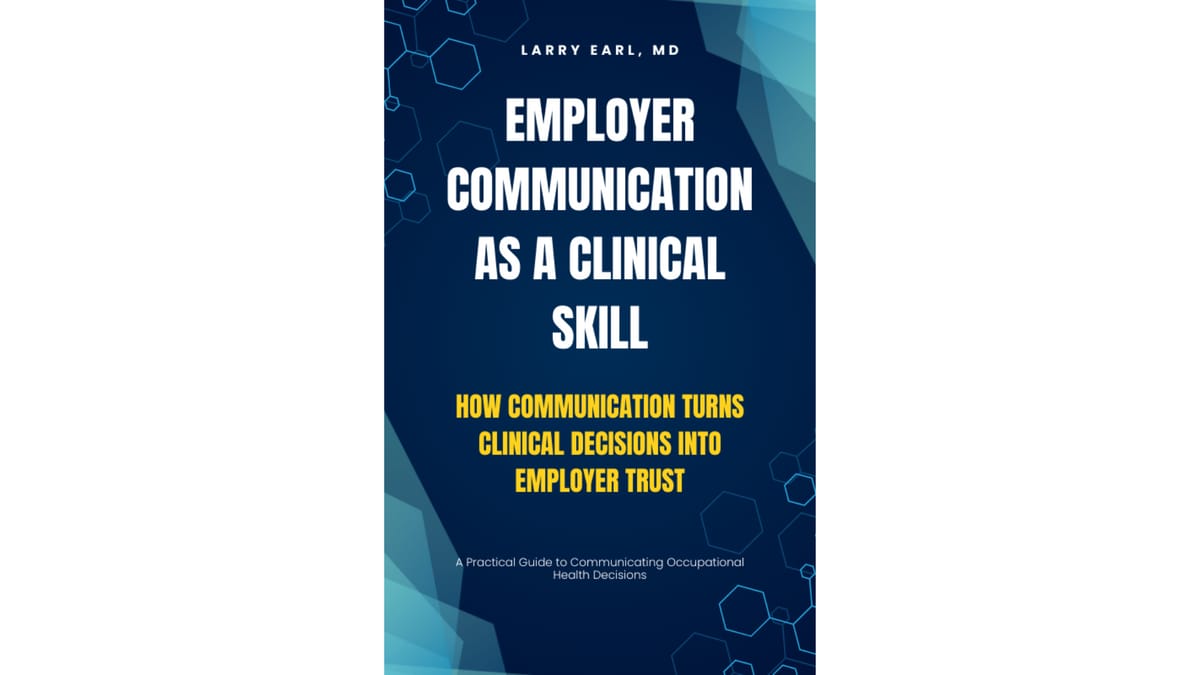
Larry Earl, MD is the President of the National Association of Occupational Health Professionals (NAOHP) and author of Employer Communication as a Clinical Skill and From Transactions to Partnerships: How Occupational Health Clinics Build Employer Trust, Predictable Workflows, and Long-Term Revenue.